HOUSING
The Housing Program for the Little Shell Tribe is currently working on these programs to help members of the Tribe that qualify for these services.
HOUSING ASSISTANCE PROGRAM
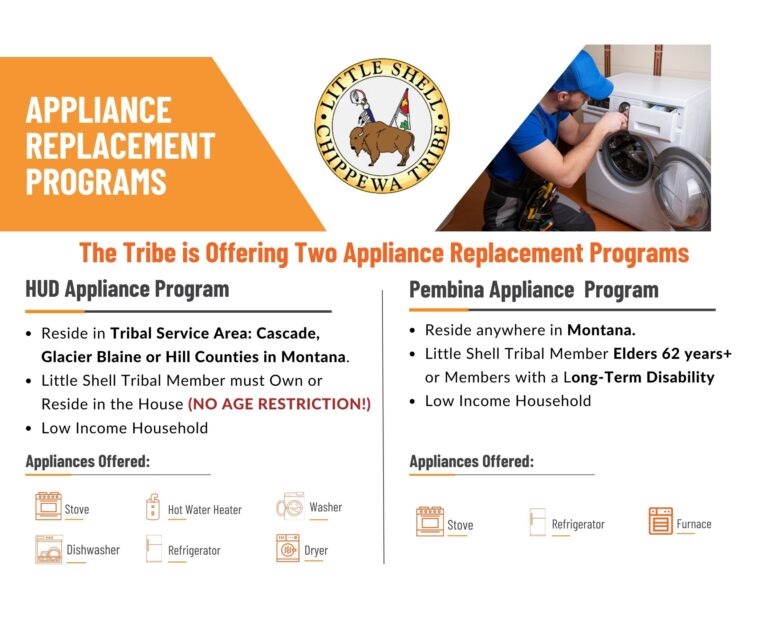
The Little Shell Tribal Council established the Housing Assistance Program (HAP) to improve the housing conditions of Little Shell tribal homeowners by replacing, removing, or repairing housing defects. The Tribal Council has recognized the need to ensure that our members have energy efficient appliances that are reliable and dependable.
The HAP Appliance Upgrade Program will provide appliance upgrades for appliances that do not meet current energy efficiency standards. Additionally, all major appliances will be evaluated for safety issues and replaced as necessary to mitigate any issues identified. Appliance upgrades will require a home inspection by the Housing Department HAP Coordinator to validate the need for upgrades and to determine replacement specifications.
Appliances Eligible for Upgrades:
- Refrigerator / Freezer Combo
- Gas Stove / Electric Range
- Dishwasher
- Hot Water Heater
- Clothes Washer
- Clothes Dryer
For all questions, please email [email protected] or call (406) 315-2400 ext. 133. The Housing Department is scheduling in-person consultations to provide help on the application by appointment only.
Eligibility Requirement:
- Little Shell Tribal Member – The Applicant must be a currently enrolled Little Shell Tribal Member.
- Homeownership – The LST Applicant must own or co-own the residence. The LST Applicant may qualify if an immediate family member (spouse or other family member) owns the home. The LST Applicant must live in the residence full time.
- Live in Cascade, Blaine, Hill or Glacier Counties – The LST Applicant must reside in Montana. The LST Housing Department ha expanded their service areas.
- Household Income – Applicant’s household must be at or below HUD’s Low Income Household Income Limits: 80% of Median Income ($53,600 for single person household or $76,550 for a 4 person household).
LS HAP Application
Pembina Appliance Program
The Little Shell Tribal Council established the Pembina Fund Appliance Program to provide emergency appliance assistance to Little Shell tribal elders and disabled tribal members. Approval for emergency assistance will be done on a case-by-case basis. The Program is funded by the Tribe’s allocation of the Pembina Settlement, therefore, funding is limited.
- The Program is available to Little Shell tribal homeowners living in Montana.
- The Program is currently only offering to repair or install a new furnace, refrigerator, and/or a stove.
To see if you are eligible, review the application today!
LITTLE SHELL TRIBE GOOD MEDICINE COMMUNITY HOUSING DEVELOPMENT PROJECT
The Little Shell Tribe of Chippewa Indians of Montana (“Tribe” or “Little Shell Tribe”) is planning its first housing development, the Good Medicine Community, marking a historic step for the Tribe in establishing a family-focused community for its tribal members.
In late 2023, the Little Shell Tribe purchased the nearly 18-acre property for the sole purpose of establishing the Tribe’s first housing development. The Good Medicine Community represents a thoughtful and transformative investment in housing and community development. The development will include nearly 100 housing units consisting of single-family homes, duplexes, and multi-family, along with essential community amenities such as walking paths, parks, and gathering spaces. This project will provide safe, stable and culturally grounded housing opportunities for tribal members and their families, addressing a critical need while strengthening the social fabric of our region.
ANNEXATION & ZONING FREQUENTLY ASKED QUESTIONS
Our Story
The Little Shell Tribe of Chippewa Indians of Montana is one of the most recently federally recognized tribes in the country. The Tribe’s federal recognition was restored in 2019 after generations of perseverance. Since that time, we have worked quickly and deliberately to build capacity, create opportunity, and contribute to the communities we call home—especially here in Great Falls, where nearly twenty percent of our tribal citizens live.
In just a few short years, the Tribe has:
• Established housing programs and services for tribal citizens
• Invested in local health, education, and community services
• Partnered with local governments and organizations
• Created jobs and economic activity in the region
For nearly 150 years, the Little Shell Tribe fought to restore its federal recognition. Today, we are working to be good partners, good neighbors, and good stewards of the opportunities in front of us.
The Good Medicine Community (“GMC”) project is part of that journey.
The Little Shell Tribe is grateful for the chance to build—not just housing—but relationships and a stronger community together.
The Little Shell Tribal Housing Department developed frequently asked questions below to address common topics and concerns raised in community and tribal meetings regarding the Tribe’s request to annex the property into the City of Great Falls where the development is proposed.
What is the Good Medicine Community project?
Good Medicine Community is more than a housing development—it is an effort to create stability, opportunity, and belonging in an area of Great Falls with historical significance to many tribal citizens and their families.
The project is a planned neighborhood on approximately 18 acres that will include:
• A mix of homes for families, individuals, and elders;
• Open green spaces where people can gather;
• Infrastructure built by the Tribe to City standards; and
• Walking paths and playgrounds to support outdoor physical activity.
Our goal is to create a place where people can build their lives with dignity and security.
Why is the Tribe building this project?
The Tribe understands that one of the biggest challenges facing Montanans today is finding and maintaining affordable housing. Undoubtedly, housing is one of the most urgent needs we see every day. We hear from tribal citizens who struggle to find stable housing, are priced out of the market, and want to stay in Great Falls, but lack options.
The Good Medicine Community is our response. It is about meeting real needs while strengthening the broader community. The Tribe, by providing affordable housing for our tribal members, will ease the pressure on the Great Falls’ housing programs and the local housing market in general.
Why are you seeking annexation into the City of Great Falls?
We chose annexation because we want this project to be part of the City’s long-term planning and be served by City infrastructure and emergency services. We believe the best way to build trust is to work within the same systems that serve everyone else.
Who will be responsible for the project?
The Tribe is responsible for funding and building the project and the City of Great Falls reviews, approves, and inspects the work. This partnership ensures that the project meets public standards and community expectations.
Who pays for the roads, water, wastewater, and other utilities?
The Tribe is responsible for funding and building the infrastructure to support the project, including:
- Water and wastewater systems;
- Stormwater systems; and
- Roads and sidewalks.
We are also required to provide financial guarantees to the City to ensure everything is completed properly.
How do we know the work will actually be completed?
We understand this concern. That’s why the City requires and the Tribe agrees to:
- Provide financial security greater than the cost of construction;
- Complete key infrastructure before homes can be occupied; and
- Comply with City oversight.
These safeguards ensure that this is a promise backed by enforceable commitments.
Will the Tribe pay its taxes?
Yes—the Tribe will pay all assessed taxes under state and city law. The Tribe currently pays all required taxes as assessed under state and county requirements.
Will this project place any costs on current Great Falls residents?
No, the Tribe is funding the infrastructure and agreeing to maintain roads and sidewalks separate from the City. Additionally, new households will contribute to the local economy and support long-term, responsible growth. We are committed to working with the City to ensure this project meets our shared goals to responsibly respond to growing needs for new and expanded housing options in the area.
Will there be more traffic?
Yes—any new neighborhood brings change. Based on the City’s traffic analysis the project is expected to generate about 950 total trips per day at full buildout. To put that in context, the land was historically planned for additional phases of the Valley View subdivision. Earlier plans would have generated similar traffic increases without an outlet to Stuckey Road. Because the City anticipated housing growth in this area, the surrounding road system was originally planned to accommodate additional traffic.
Where will the traffic go?
The City’s analysis expects that the majority of traffic will use Stuckey Road to the west of the development, while others will use 10th Avenue NW. This means that most traffic will avoid existing neighborhood streets and reduce congestion.
How will the project support safety and walkability?
We are designing the neighborhood with people in mind. GMC will have sidewalks and accessible routes; setbacks that keep vehicles off pedestrian paths; and streets designed for safe movement. We want this to be a place where children can walk, neighbors can meet, and people feel safe.
A new connection to Stuckey Road will improve connectivity and safety by providing additional access for emergency access and evacuation.
How will this project fit into the existing neighborhood?
The Tribe has listened to concerns about compatibility. The design reflects that by directing most traffic away from the Valley View neighborhood, connecting to larger roads designed for higher volumes, and including sidewalks and safer street layouts. We are committed to building something that fits, not something that overwhelms.
Who will live here?
This development is intended to serve Little Shell tribal citizens directly, but will have indirect benefits to the larger Great Falls community, because it also contributes to the overall housing supply.
More housing options help:
- Reduce pressure on existing neighborhoods;
- Support workforce stability; and
- Strengthen the local economy.
We see this as a project that supports both our Tribal community and the wider City.
Who takes care of the infrastructure over time?
These responsibilities are clearly defined and legally binding in the Improvement Agreement. Generally, because the infrastructure is publicly owned the City maintains the systems like water and wastewater, just as they would in any other development. The Tribe will maintain private infrastructure, including sidewalks and roads.
What ensures the project is built the right way?
The project must meet strict requirements, including City-approved engineering plans, inspections during construction, a warranty period after completion, and financial guarantees to fix any issues
.
What does this project mean for the future?
Good Medicine is about more than buildings. It represents a step toward housing stability, a meaningful partnership between the Tribe and the City, and a shared investment in the future of Great Falls.